
Last Updated on March 29, 2026 by Chicago Policy Review Staff
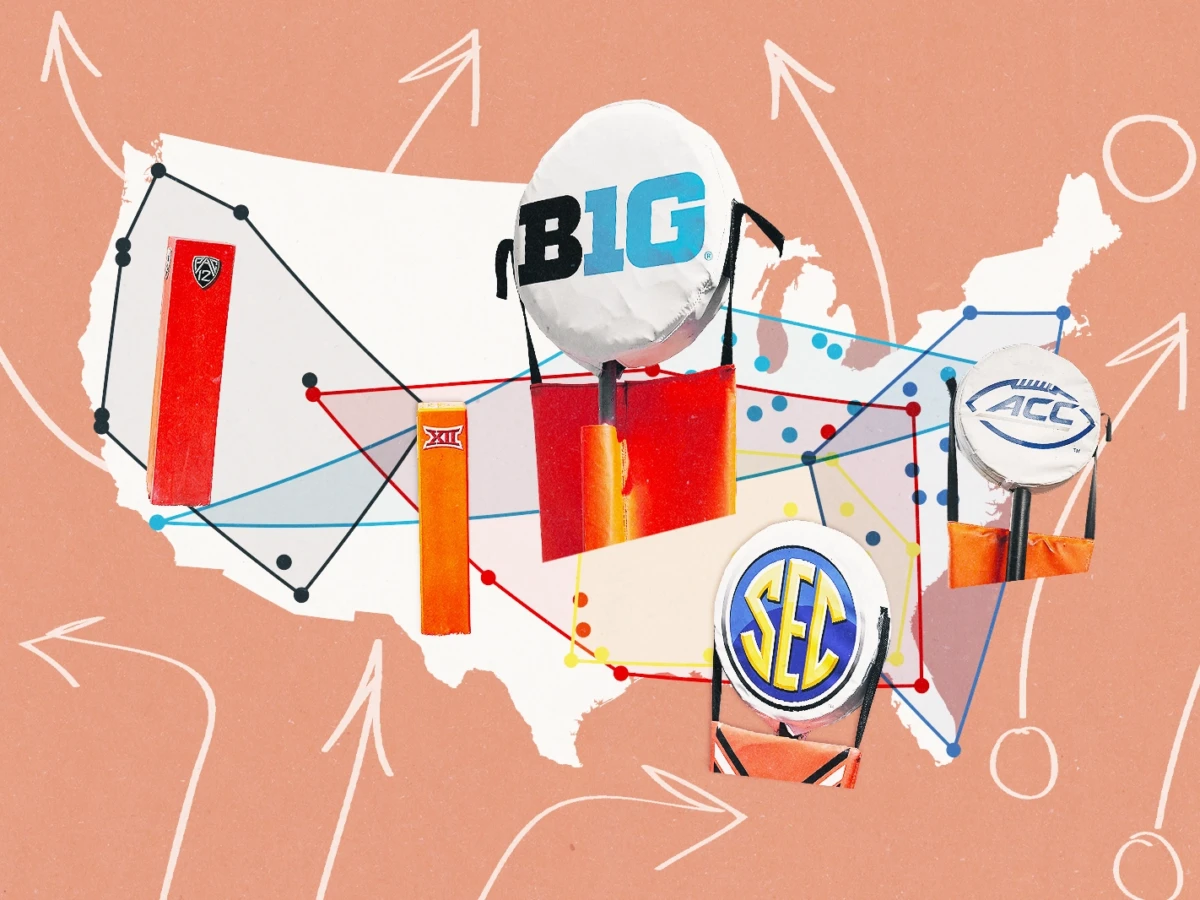
College athletic conferences organize the economic and competitive structure of college sports. These leagues group universities into regional affiliations that coordinate scheduling, negotiate shared television contracts, and determine postseason competition. Two of the most prominent were the Pac-12 Conference, historically composed of major West Coast universities, and the Big 12 Conference, a league centered primarily in the Midwest and Texas. On August 4, 2023, the University of Colorado announced it would leave the Pac-12 Conference for the Big 12. Within weeks, Arizona, Arizona State, and Utah followed suit. By September, Stanford and the University of California, Berkeley accepted invitations to the Atlantic Coast Conference, requiring their athletes to traverse 2,500 miles for conference competition. Oregon and Washington joined the Big Ten for reduced revenue shares rather than remaining in a dissolving conference. What had been a Power Five conference comprising premier West Coast universities was reduced to Washington State and Oregon State, two schools now litigating for relevance.
What appears as routine scheduling changes is, in reality, an accelerating consolidation of media leverage within a handful of conferences. The Big Ten expanded from 14 to 18 schools, absorbing media markets from Los Angeles to Seattle. The SEC secured Texas and Oklahoma, maintaining southeastern dominance. Together, these conferences now control approximately 60 to 70% of total conference media rights revenue and access to resources necessary for competitive viability. A $50 million annual revenue disadvantage compounds into obsolescence. The result is increasing market concentration, with two conferences now dominating media revenue and competitive access across major college athletics.
Conference executives and university presidents drove the Pac-12’s collapse through decisions prioritizing media revenue above all else. It began when USC and UCLA negotiated secretly with the Big Ten in 2022, attracted by the conference’s $7 billion media deal promising $60-80 million per school annually. The Pac-12’s failed negotiations could offer only $20-30 million per school, creating a 3:1 revenue differential that became existential. This market consolidation proceeded without antitrust review. If major airlines divided the United States into exclusive territories or hospital systems merged to control regional markets, federal regulators would investigate. Conference realignment faces no such scrutiny. In a properly regulated sports economy, horizontal consolidation at this scale would trigger federal review. Instead, realignment proceeds through private agreements among powerful institutions reallocating billions in value without meaningful oversight.
Each institutional decision was individually rational yet collectively destructive. No mechanism existed to internalize defection costs, no enforcement power prevented departures, and no governance body was there to meaningfully regulate structure. Athletes who chose Pac-12 schools based on geography and conference identity found those commitments worthless.
If conference realignment faced the same antitrust scrutiny applied to other industries, these three structural blind spots would become immediately visible. First, antitrust doctrine remains unclear about whether conferences function as single entities or as collaborations among independent competitors. The Supreme Court’s 2010 decision in American Needle v. NFL established that NFL teams are “separate, profit-maximizing entities” that compete with one another despite cooperating to produce a joint product. Conference realignment presents a similar question. If expansion decisions are necessary coordination to produce college athletics as a joint product, conferences might claim single-entity treatment insulated from Sherman Act scrutiny. If instead they represent agreements among independent universities allocating markets or competitive opportunities, those decisions could fall within traditional antitrust review.
Second, nonprofit educational status shields commercial coordination from scrutiny even when decisions are driven entirely by media revenue. The Supreme Court’s 1984 decision in NCAA v. Board of Regents recognized that some restraints may preserve college sports as distinct products, but it applied full Sherman Act analysis and struck down anticompetitive restrictions. Conference realignment proceeds on bare assertions of educational purpose without supporting evidence. In this case, geography did not constrain expansion, academic alignment was irrelevant, and no one consulted athletes about the consequences. The consequences appear most clearly in the travel demands imposed on athletes. Stanford and Cal athletes now average roughly 2,200 miles per road conference game. Studies document negative correlations between travel burdens and academic performance, while disrupted sleep and time zone adjustments reduce recovery time. Universities claiming to prioritize student-athlete welfare made decisions that demonstrably harmed both academic success and competitive performance.
Third, labor market impacts remain invisible because athletes are not legally recognized as workers. Conference realignment directly affects athletes through increased travel burden, disrupted academics, broken recruiting promises, and foreclosed professional pathways. But because athletes are classified as “student-athletes” rather than employees, labor market analysis plays no role in competitive review. The emergence of Name, Image, and Likeness (NIL) compensation does not alter this analysis: athletes may earn endorsement income, but they remain legally classified as nonemployees of their universities, leaving the labor market effects of conference consolidation outside formal antitrust and labor scrutiny.
The racial dimension compounds these harms. In the revenue sports that drive realignment’s media value, approximately 55 to 60% of the athletes are Black, far exceeding Black representation in general student bodies. When conferences reallocate this value, benefits flow primarily to white administrators and coaches. Black athletes generate increased media value while white decision-makers capture it, perpetuating historical patterns where amateurism rules prevented compensation while institutional actors built wealth from athlete labor.
The NCAA, weakened by the Supreme Court’s decision in National Collegiate Athletic Association v. Alston (2021), no longer regulates conference structure effectively. Post-Alston, conferences began operating independently, expanding membership and restructuring competition without NCAA involvement. Federal agencies have not investigated despite possessing the authority to do so. The Department of Justice and the Federal Trade Commission defer to universities as educational institutions and face political sensitivity around challenging flagship state universities.
Market power continues concentrating, competitive imbalance grows more severe, and the costs of conference consolidation fall increasingly on athletes. With athlete compensation litigation expanding, state NIL laws proliferating, and conference fragmentation accelerating, the question is no longer whether accountability will emerge, but what form it will take and how much harm will occur before it does.