
Last Updated on September 8, 2026 by Chicago Policy Review Staff
On June 12, the Commerce Department ordered Anthropic to block foreign-national access to Fable 5 and Mythos 5. The order lasted only 18 days, but it crossed a threshold. Washington had intervened not merely in the chips, capital, or model weights behind frontier AI, but in access to named, already deployed commercial models.
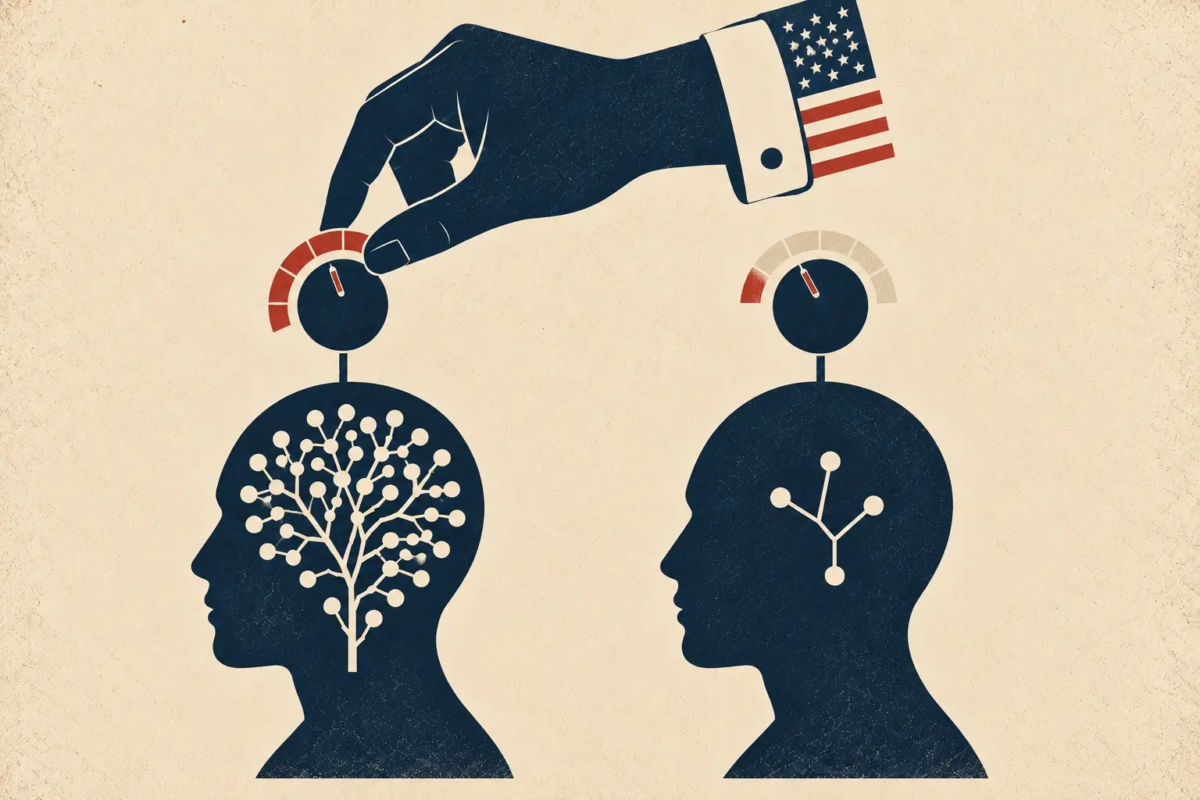
The intervention points toward a regime of export-grade intelligence. This would be more than the country-based tiering contemplated by the former AI Diffusion Rule. It would be capability tiering: different countries could receive different versions of the same American AI systems, with access to their most advanced capabilities varying by partner. Foreign users would receive access to hosted systems whose performance, tools, deployment conditions, updates, monitoring, and continued availability remain under the provider’s control, with that control increasingly subject to Washington’s influence.
Such a regime would not require Washington to own the models; its control over frontier AI remains indirect and incomplete. It can restrict advanced chips, impose conditions through federal procurement and export licenses, and use government contracts to shape developer behavior. But the labs remain private firms whose growth depends on global adoption and whose scale is funded by vast amounts of capital, computing power, users, and market access. In 2025, American AI companies attracted nearly $286 billion in private investment. The Pentagon, meanwhile, has awarded Anthropic, OpenAI, xAI, and Google contracts of up to $200 million each to develop frontier applications for national-security missions.
Before June, Washington had generally addressed AI risks by controlling the technologies and transactions that make frontier AI possible: advanced chips, investment, and sales to foreign buyers. It also required developers to provide information about their most capable models. A June 2 executive order moved closer to the models themselves, creating a voluntary process for developers to submit frontier systems for federal security review before public release. That still falls well short of government licensing, but it gives Washington another opportunity to influence when and how the most capable systems reach the market.
The Anthropic order went further. By choosing to intervene in access to a deployed commercial product, Washington revealed that it does not intend merely to be a buyer. OpenAI’s limited prerelease preview of GPT-5.6 at the government’s request on June 26 showed how that influence can operate even without a formal prohibition.
From Export Control to Capability Control
During the Cold War, the United States and its allies restricted transfers of computers, semiconductors, machine tools, and other dual-use technologies to the Soviet bloc. The regime was imperfect, but its premise was clear: commercial transactions could alter the military balance. Controls loosened sharply around the Cold War’s end, though strategic dual-use controls remained. What followed was a much broader diffusion of American commercial technology across the global economy, from software and computing infrastructure to cloud services and advanced semiconductors.
Whether or not Washington designed this diffusion as a coherent grand strategy, it served American power: it spread U.S. standards, expanded the scale of American firms, and embedded foreign economies in American infrastructure. Selling technology widely was unipolar statecraft by other means.
The global reach of American operating systems, smartphones, cloud services, and AI chips made commercial access feel less like a policy choice than a permanent feature of the digital economy. That model allowed U.S. companies to earn abroad, reinvest at home, and set technical defaults that competitors and governments had to accommodate.
Middle powers came to expect that leading American technology would remain available. Europe absorbed this assumption most deeply. The transatlantic technology relationship was not established by any single agreement; it accumulated through security ties, trade, and private investment until American technology became so deeply embedded that it is now a strategic dependence.
China’s rise and frontier AI challenge the conditions under which that diffusion appeared strategically cheap. Against a peer competitor, relative gains matter more: frontier capability released globally can be absorbed, copied, or distilled and used to strengthen the other side. Below the frontier, however, broad diffusion still spreads American standards, deepens dependence on American platforms and cloud infrastructure, and sustains the commercial scale that funds the next generation of models. The task is not to suppress diffusion, but to preserve those gains while placing the most advanced systems under controlled, revocable access.
Earlier technologies had security implications, but frontier AI is a general-purpose multiplier. The same systems that drive productivity and research gains can accelerate vulnerability discovery, code generation, intelligence analysis, scientific research, autonomous operations, and military planning. Their concentrated production gives Washington leverage, while cloud delivery can make restrictions enforceable. Unlike technology that is simply sold and transferred, access to a hosted U.S. model can remain under continuing control after it reaches the user: it can be monitored, reconfigured, limited, or revoked. Because those capabilities cross civilian and military domains, ordinary commercial access can become a strategic transfer.
The Trump administration’s recent approach appears to be reviving the Cold War premise under radically different conditions. The labs will remain businesses, but their relationship with Washington will resemble a Lockheed Martin security layer over Microsoft economics. The relevant similarity is not ownership or corporate identity. It is continuing control over customer eligibility, configuration, software updates, monitoring, and permitted use after the product has been delivered.
American control will have real limits. It is strongest when an American company continues to host the model and weakest once technology, expertise, or model capabilities have spread beyond its control. Foreign providers and open models will give some users alternatives, and Washington’s authority over private companies will not be unlimited. If restrictions are too broad or unpredictable, they may accelerate the alternatives they are meant to forestall by pushing allies to build sovereign capacity or deepen ties with China. The United States therefore cannot command a new allied hierarchy by decree. Its leverage will endure only if the capability gap remains large enough to make American access valuable and the terms of dependence remain credible enough that allies prefer to stay.
What Allies Will Negotiate Over
This shift does not require technological decoupling. The United States will keep exporting chips, cloud services, applications, and selected models because global adoption sustains the scale and influence of American firms. The more likely outcome is a system of stratified interdependence: broad access below the frontier and increasingly selective access at the top, with different partners receiving different capabilities, on different terms, and with different assurances that service will continue.
Defense exports offer a rough precedent. The United States has sometimes reserved its most advanced capabilities for itself while providing allies with highly capable but more controlled alternatives. Frontier AI may follow the same pattern: the most powerful systems could remain restricted to domestic use, while allies receive versions that are delayed, monitored, limited, or revocable. The difference is that a fighter aircraft is largely fixed once delivered. A hosted AI model is not. Washington and the provider can continue changing what it can do, who can use it, and whether access continues at all. That makes capability itself a standing subject of alliance politics.
Some middle powers can bargain with critical pieces of the supply chain: the Netherlands through ASML’s lithography systems, Taiwan through TSMC’s leading-edge fabrication, and Gulf states through capital and energy. These chokepoints buy leverage, but none amounts to a full frontier-AI stack—and the more indispensable a foreign node becomes, the more pressure Washington feels to reproduce it at home.
Europe possesses market size, wealth, industrial depth, and leading research institutions, but it lacks an integrated capital market, abundant low-cost energy, hyperscalers at American scale, and a unified procurement system capable of sustaining repeated frontier-model investments. Even wealthy governments struggle to coordinate the capital, electricity, procurement, and technical talent needed to train one generation of models and then finance the next.
Turning toward the Chinese AI ecosystem would therefore exchange dependence on the United States for a dependence that is likely to be deeper, harder to contest, and more damaging to European industry—the risk already visible in Europe’s experience with Chinese electric vehicles.
Europe’s near-term strategy is to negotiate within the American ecosystem for enforceable access rights while rebuilding indigenous capacity wherever a loss of access would be intolerable, including energy and grid expansion, public and sovereign compute, and secure data infrastructure. Negotiated dependence is still dependence, but clear rules can make it less vulnerable to sudden political pressure.
Once capability tiers exist, close allies such as Japan, the United Kingdom, Australia, and a narrower set of European states will negotiate for better models, shorter delays, and clearer guarantees against abrupt revocation. Other partners may receive more constrained versions, subject to tighter monitoring and shorter notice of withdrawal. These differences will not merely reflect existing levels of trust; they will shape them. Access to American AI will become an alliance benefit that can be expanded, conditioned, or withdrawn.
Washington should establish an allied-access framework before improvised interventions harden into a hierarchy that no ally helped design. At minimum, allies will need answers to three questions: what determines the level of capability they receive, under what circumstances that access can be restricted, and what protections they have against abrupt withdrawal. The framework should distinguish access to hosted models from transfers of model weights and clarify when government security concerns can alter an otherwise commercial release. Those guarantees should be reciprocal. Allies receiving higher-tier access should commit to common cybersecurity standards, incident reporting, end-user controls, and limits on onward transfer. The goal should be to make revocation an emergency safeguard rather than a routine instrument of leverage. Without those assurances, every exercise of American control will strengthen the case for technological hedging against the United States.
States have long restricted technologies with military applications. What is new is the position from which the United States is doing so: American companies built the platforms, infrastructure, and standards on which much of the world depends, while American security guarantees encouraged allies and middle powers to treat access as durable. Restrictions on frontier AI will therefore reshape relationships the United States has built over decades. Washington can no longer decide how to control its most capable models solely by asking what those controls deny China. It must also ask whether they teach allies that dependence on American technology is itself a strategic liability.