
Last Updated on June 2, 2026 by Chicago Policy Review Staff
The Neo-Cold War
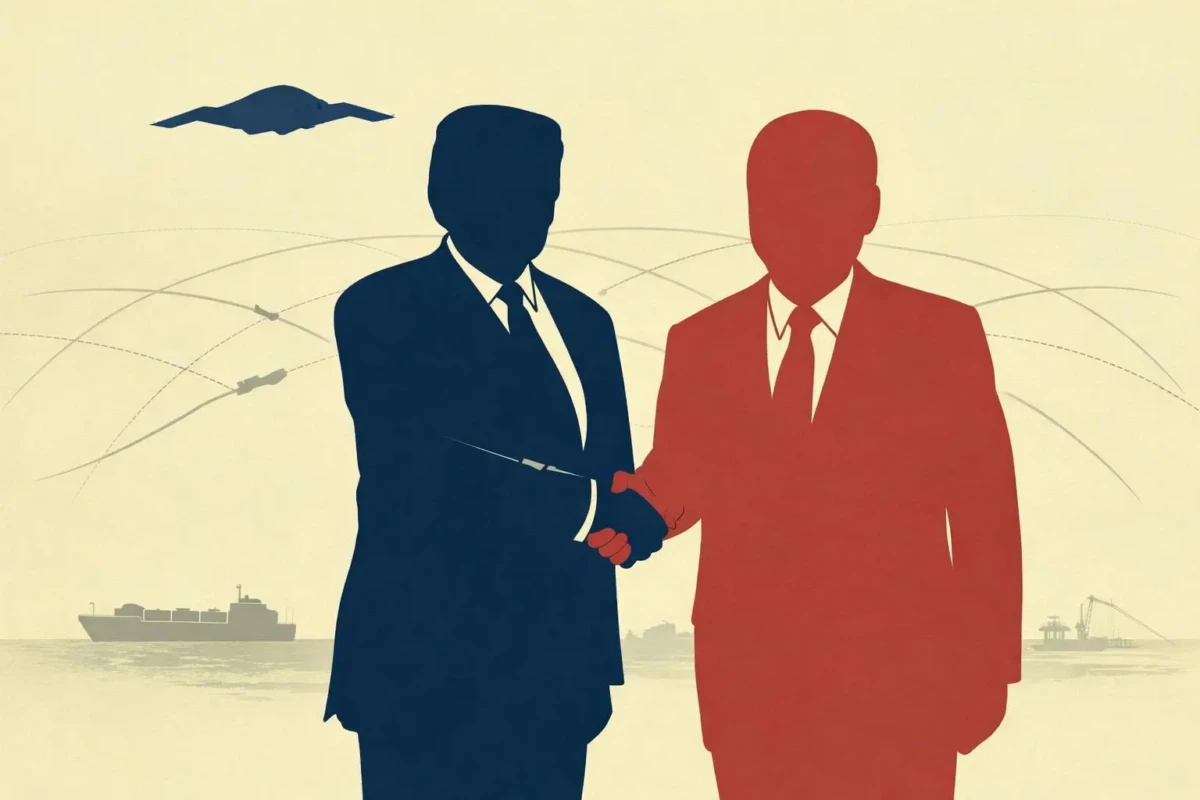
The United States is in the midst of a neo-cold war with China. What the Trump administration is executing, whether by design, instinct, or structural inevitability, is a grand strategy of convenience: a convergence of individually motivated actions that collectively pressure the global resource, energy, and influence networks that sustained China’s rise.
These moves were not sold as one coherent China strategy. Since January, the Trump administration has moved aggressively across seemingly unrelated fronts around the world. It ousted Maduro in Venezuela and reasserted the Monroe Doctrine. Against Iran, it launched a war alongside joint strikes with Israel on February 28 that killed Supreme Leader Ali Khamenei. In Cuba, it imposed an executive-order oil blockade on January 29 that has since collapsed the island’s grid three times. It imposed a global tariff regime so broad it disrupted trade relationships with allies and adversaries alike. Each decision is dismissed in isolation as Trumpian impulse. In the macro, however, those choices produced a common structural effect: the systematic severing of the infrastructure China built to resist American hegemony.
China spent two decades embedding its influence in exactly the spaces American power had vacated: Latin American petrostates, sanctioned Middle Eastern regimes, critical mineral supply chains with no Western competition. When any American president re-expands into those spaces, for whatever reason, the pressure on China is inherent. An emboldened and powerful America reasserting dominance simultaneously does not need to consciously target China in each move.
China’s response to these pressures has been strongly worded statements. That is what you issue when the alternative is escalation you cannot win.
Pull on any thread, Venezuela, Iran, Cuba, critical minerals, global supply chains, and it will conveniently connect back to Beijing. In each case, the pressure produced convergent effects that no single policy could achieve in isolation. China built its influence so deeply into the architecture of anti-American relationships that any serious reassertion of American interests’ primacy automatically disrupts it.
The Deeper Mechanism
The American order is built on alliances and security guarantees. China’s competing order is built on finance and infrastructure, a distinction that explains both the scale and the fragility of China’s global position. Beijing’s model operates through capital commitments: loans, infrastructure investment, energy contracts, and mineral extraction deals that create economic dependencies favorable to China. But capital investment creates dependencies; it does not create defenders. There is no NATO equivalent that rallies when Beijing’s Belt and Road allies are confronted.
This is a neo-cold war. It is not a contest over political systems, nor an ideological confrontation like the one the United States fought with the Soviet Union. Today, the neo-cold war is structural: chips, supply chains, financial networks, and the physical territories from which strategic materials are extracted.
China’s dominance across each of these fronts was engineered, not earned. It ascended through favorable deals with a West eager for cheap exports, alongside currency manipulation and massive industrial expansion. While the West envisioned economic integration and affordable goods, it eventually realized that a core feature of China’s power is the heavy subsidization of domestic industries. This allows China to project power externally, annihilating global competitors that cannot compete with state-sponsored predatory pricing.
While cheap energy was just one cog in a larger subsidization machine, it was an understated one. Every barrel of below-market crude bought Beijing more room to undercut competitors and extend its influence, more time to outlast foreign producers, and more market share to consolidate once they folded.
China imported approximately 11.6 million barrels per day in 2025. Of that total, at least 2.6 million barrels, over 22 percent of all Chinese crude imports, came from sanctioned producers: 1.38 million from Iran, roughly 389,000 from Venezuela, and over 800,000 from Russia. Sanctioned crude sold at discounts of $8 to $15 per barrel below market rate, depending on origin. The cheap oil pipeline from Caracas and Tehran was a mechanism for China to expand its influence by directly subsidizing America’s adversaries while undercutting American companies who operated under market constraints.
Venezuela
For twenty years, Venezuela was China’s most important client state in the Western Hemisphere. Beijing loaned Venezuela nearly $60 billion over two decades, securing crude at steep discounts through debt-for-oil arrangements. The logistics relied on tankers running with AIS transponders switched off, ship-to-ship transfers, and relabeled cargo designed to evade sanctions: an opaque network keeping Chinese refineries fed and an authoritarian regime alive.
While American special operations forces moved into Caracas and arrested Nicolás Maduro, Chinese diplomats slept in their Caracas hotel rooms. When they woke up, they drafted a strongly worded statement. That scene, American forces arresting a leader whose survival hinged on Chinese support while Chinese diplomats slept in the next room, unable to do anything about it, was the neo-cold war in 24 hours. China’s special envoy for Latin America, Qiu Xiaoqi, had met with Maduro hours before the operation, unaware that it would be their last. Suddenly, in the middle of the night, a pillar of the anti-American axis of resistance was severed overnight.
Weeks later, the first sale of Venezuelan crude under American guidance brought in $500 million, denominated in U.S. dollars. Venezuela’s oil, which had been a cornerstone of Beijing’s de-dollarization strategy in Latin America, is now being sold in the currency China has spent years trying to displace. Cumulative sales under U.S. oversight surpassed $1 billion by mid-February and were projected to add roughly $5 billion in the following weeks. By April, India had overtaken China as the largest buyer of Venezuelan crude, reversing two decades in which Beijing accounted for roughly 80 percent of exports. The American position in Venezuela is now one that Beijing cannot contest militarily and cannot reverse economically.
Cuba
The fall of Caracas did not stop in Caracas. For two decades, Havana survived on a triangular arrangement: Beijing financed Venezuela, Caracas shipped subsidized crude to Cuba, and Havana supplied doctors and security personnel that helped keep Maduro in place.
Cuba was already in collapse before Maduro fell. Venezuelan crude shipments to the island, once roughly 80,000 barrels per day, had dwindled to a fraction of that as Venezuela’s own production deteriorated. Rolling blackouts of twelve to twenty hours a day became routine across most of the island in 2024 and 2025.
China is one of Cuba’s largest creditors, with debts to Chinese state banks running into the billions, much of it in arrears. Huawei built and operates the backbone of Cuba’s telecommunications network. None of these investments produced the kind of emergency support that would have kept the Cuban regime liquid in oil and dollars after Venezuela’s collapse. Beijing finances, but it does not rescue. Cuba is the second Western Hemisphere link in the Chinese network to crack in the same year.
Iran
China kept Iran economically alive. When Western sanctions tightened, Chinese firms filled the void. China purchased approximately 90 percent of Iran’s oil exports, roughly 1.38 million barrels per day. China was negotiating to sell Iran the CM-302, a supersonic anti-ship cruise missile with a 550-pound warhead, designed to sink American ships in the Arabian Sea. This convenient arrangement was structured to contest America. The only commonality between China and Iran is their shared enemy, Washington.
Tehran assumed that Chinese economic support implied Chinese strategic commitment or that Beijing would intervene in some way, if the United States attacked. It did not. When the February 28 U.S.-Israeli joint strikes killed Supreme Leader Ali Khamenei and triggered eight weeks of war culminating in a conditional ceasefire on April 8, Beijing condemned the strikes as a violation of the UN Charter and did nothing else. Iran discovered the weakness of Beijing’s strategy: China will buy access, but it won’t protect that access with security commitments when pressure becomes existential.
The Limits
The converging pressures disrupts China’s resource network. It does not displace China’s industrial base.
That distinction is vital because the two rest on different foundations. China’s resource network, the sanctioned oil, the debt-for-commodity deals, the mineral extraction agreements, depends on access: access to regimes, to trade routes, to markets operating outside American oversight. The Grand Strategy of Convenience is effective against networks built on access because access is binary. You have it or you do not.
Industrial capacity is different. It is built on accumulated investment, technical knowledge, workforce depth, and economies of scale that do not disappear when a trade route closes. Export controls deny Beijing access to the frontier of semiconductor technology yet Huawei adapted and Chinese AI labs are among the best. CATL’s dominance in battery manufacturing does not depend on access to a sanctioned regime; it depends on a decade of state investment, process optimization, and vertical integration that no tariff schedule undoes. China’s near-monopoly on rare earth refining is not a supply chain vulnerability in the way that Venezuelan oil was; it is the supply chain, and Western alternatives are years from operational scale. The convergence pressures what China imports. It does not touch what China builds.
The strategy also cannot resolve the alliance problem its own tactics create. The brazenness of Trump’s foreign policy has confronted Chinese interests while simultaneously straining relations with allies.
Beijing
The neo-axis of resistance that connected Chinese capital to authoritarian survival across three continents is cracking. The discount oil pipeline from Venezuela is severed; the equivalent flow from Iran is reduced and structurally exposed. The Cuban regime, the third leg of Beijing’s Western Hemisphere position, is operating without the energy and dollars that sustained it and is now negotiating its terms with Washington. The structural effect on China’s global network is measurable and accelerating. China’s resource network is not a background condition of global politics. It is embedded in every domain where American power is being reasserted.
The grand strategy of convenience does not require a grand strategist. It requires a hegemonic posture aggressive enough that every assertion of power, for whatever reason, in whatever domain, degrades the network of a rival that built its influence in the spaces the hegemon had vacated. China embedded its position so deeply in sanctioned states, mineral chokepoints, and adversarial supply chains that any reassertion of American primacy automatically disrupts it.
When Trump and Xi sit down in Beijing, the bargaining will be about economics and shared interests. The negotiation that mattered has already happened, across three continents and ninety miles off the Florida coast, without either leader in the room.