
Last Updated on April 23, 2026 by Chicago Policy Review Staff
This interview was conducted by Chicago Policy Review (CPR) in collaboration with the Center for Latin American and Caribbean Studies (CLACS) at the University of Chicago. Interview conducted by Nicolás Mayorga, Senior Editor at Chicago Policy Review.
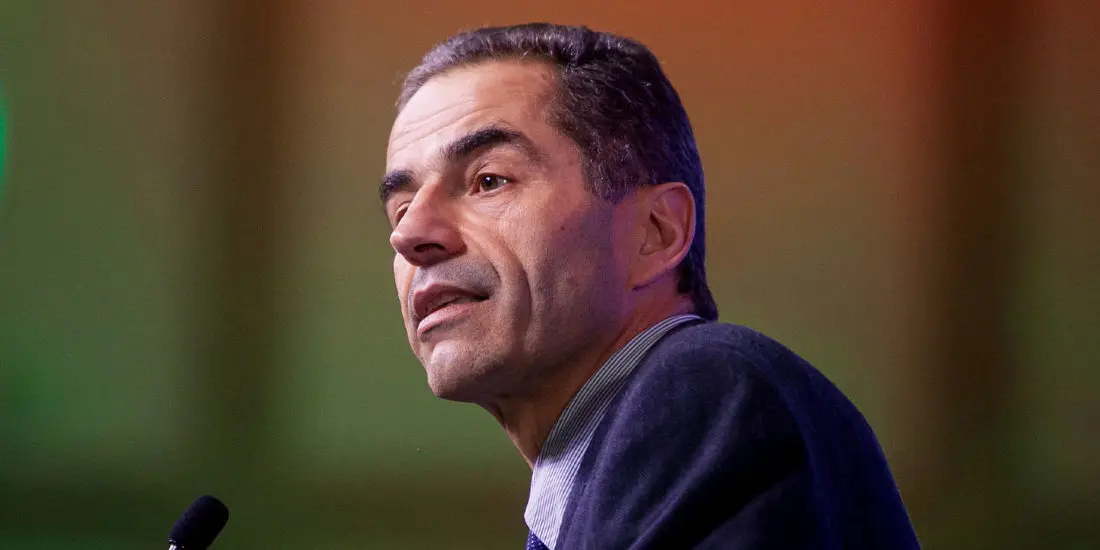
Manuel Heitor, who served as Portugal’s Minister of Science, Technology, and Higher Education from 2015 to 2022, is currently Full Professor at the University of Lisbon and holds academic appointments at New York University and Harvard University. A leading advisor on European Union research and innovation competitiveness, he discusses the European Union’s innovation future, competition with the United States and China, the need to improve opportunities for younger generations, and why Latin America should view Europe as an increasingly relevant partner.
Cover Image credited to IAFOR. We do not claim any rights to the image.
Nicolás Mayorga: Professor Heitor, thank you for joining us. To begin, could you tell us about your background and what first drew you into science policy?
Manuel Heitor: Thank you for the invitation. I am an engineer by training, but above all I see myself as a European citizen. I began my studies in Lisbon, later completed postgraduate and doctoral work at Imperial College London, and then pursued postdoctoral research in California. After that, I returned to Portugal and built an academic career.
Over time, I became increasingly involved not only in engineering, but also in higher education policy, innovation systems, and the relationship between science and public purpose. Portugal was integrating more deeply into Europe, and that was a transformative moment. It created opportunities to modernize institutions, expand research capacity, and think seriously about how knowledge can support development. That path eventually led me into government, where I served for many years.
Nicolás Mayorga: Europe is often described as having world-class talent but lagging behind the United States and China in innovation. How do you assess Europe’s current position?
Manuel Heitor: Europe has enormous strengths: universities, scientific talent, democratic institutions, and a remarkable diversity of cultures and capabilities. But it has also underinvested for too long.
Funding levels per researcher remain lower than in the United States, and in strategic sectors Europe now faces intense competition from China as well. There has also been a tendency to treat fiscal restraint as a permanent framework rather than asking whether public investment is necessary for future competitiveness.
Recent crises changed that conversation. During COVID-19, Europe made research central to public policy. Vaccines depended on decades of scientific work. Europe also made decisions that would once have seemed politically impossible: common borrowing, joint recovery financing, and coordinated procurement mechanisms.
The broader lesson is that Europe can move decisively when it recognizes that science, innovation, and public investment are not luxuries—they are strategic necessities.
Nicolás Mayorga: If you could redesign one structural feature of European research funding, what would it be?
Manuel Heitor: I would strengthen science funding at the European level while decentralizing innovation funding to regional levels.
Frontier research, advanced science, mobility of talent, and what I call the circulation of ideas should increasingly be financed through common European institutions. Those are areas where scale matters and where Europe benefits from acting together. At the same time, innovation is local. Innovation in northern Finland is different from innovation in southern Italy. The needs of Lisbon differ from those of rural Spain or industrial Germany. So innovation policy should remain place-based and responsive to regional realities. Europe must think of itself as a multi-level system: continental excellence combined with local flexibility.
Nicolás Mayorga: How does Europe’s model differ from the United States and China beyond the amount of money spent?
Manuel Heitor: Governance is a central difference.
Too often, research systems are governed through administrative logic rather than scientific logic. Researchers and innovators need institutions that are independent, credible, and oriented toward excellence over the long term. One of Europe’s most successful examples is the European Research Council. It has earned prestige because it is driven by scientific quality and relatively independent governance. Europe should build more institutions with those characteristics. If science is over-managed bureaucratically, it becomes slower, more cautious, and less ambitious.
Nicolás Mayorga: You have repeatedly emphasized younger generations. Why is young talent so central to Europe’s future?
Manuel Heitor: Because no system can innovate if its youngest members are insecure.
Across Europe, many young researchers and professionals are hired through short-term contracts tied only to temporary projects. That creates precarity. It discourages risk-taking, long-term thinking, and personal stability. If we want creativity, entrepreneurship, and scientific ambition, we must provide better jobs and stronger career paths for young adults. This is not only a labor market issue. It is a question about whether societies allow younger generations to imagine a future inside their own institutions.
Nicolás Mayorga: You have linked that issue to democratic stability. How?
Manuel Heitor: In many countries, younger generations face a combination of pressures: insecure employment, expensive housing, delayed independence, and declining trust in institutions.
When people believe that effort will not lead to opportunity, frustration accumulates. That frustration can be channeled into polarization and populist politics. So when I speak about better jobs for young adults, I am not speaking only about economics. I am speaking about the health of democracy itself.
Nicolás Mayorga: The United States is experiencing disruptions in federal research funding. Could this create an opening for Europe?
Manuel Heitor: Yes, and I believe it already has.
We are seeing growing interest from researchers based in the United States who are reconsidering where they want to build their careers. Applications to major European programs have increased significantly, including highly competitive research and mobility schemes. That is an opportunity for Europe to attract global talent. But opportunities can be wasted. If Europe does not expand budgets and create pathways for these researchers, interest alone will not be enough.
Talent follows both openness and resources.
Nicolás Mayorga: So for students and early-career researchers, this may be an unusually strategic moment?
Manuel Heitor: Absolutely.
Periods of institutional change often create openings that do not exist in more stable moments. Students should pay attention to those shifts. Europe is reassessing competitiveness, talent attraction, and long-term investment. For young researchers, that means new scholarships, mobility programs, partnerships, and institutional recruitment may emerge or expand.
My advice is to act early rather than wait until everyone recognizes the opportunity.
Nicolás Mayorga: What practical advice would you give an international student trying to access Europe’s research ecosystem?
Manuel Heitor: Start with one institution.
Many people look at Europe only through large funding frameworks and become intimidated by complexity. A better strategy is to begin with a university, research center, startup, laboratory, or company.
Once you enter one institutional network, doors open to doctoral programs, postdoctoral fellowships, collaborative grants, and professional opportunities. Europe can appear bureaucratic from the outside, but in practice it is often navigated through relationships and institutional entry points.
Nicolás Mayorga: What about Latin America specifically? Is Europe truly accessible, or does it still feel designed for insiders?
Manuel Heitor: Europe must become more accessible to Latin America, and I believe it is moving in that direction.
There are historical, cultural, and intellectual ties that should be translated into stronger contemporary partnerships. Trade and cooperation agreements can also help create wider spaces for mobility, joint research, and innovation collaboration. But this relationship must be mutual. I do not believe in one-way brain drain. I believe in circulation of talent, circulation of ideas, and reciprocal gains. Europe benefits from Latin American talent, and Latin America should benefit from training, networks, investment, and stronger institutional links.
Nicolás Mayorga: Many Latin American governments are debating whether to deepen science and technology ties with the United States, China, or Europe. What should guide that decision?
Manuel Heitor: Results.
The correct question is not symbolic alignment. It is whether partnerships create stronger institutions, better jobs, higher-quality research careers, and long-term productive capacity. Any relationship that builds domestic capability and expands opportunity deserves serious consideration. Strategic autonomy begins with internal strength.
Nicolás Mayorga: If you were speaking directly to policymakers in emerging economies, what common mistake would you warn against?
Manuel Heitor: Treating science policy as separate from economic policy.
Research policy is labor policy. It is industrial policy. It is education policy. It is geopolitical policy.
If governments isolate science inside a narrow ministry without linking it to growth, employment, and competitiveness, they will underuse it. Knowledge policy must be integrated into national development strategy.
Nicolás Mayorga: Final question: what message would you give a 25-year-old anywhere in the world considering a career in science policy?
Manuel Heitor: Experiment.
Try new ideas. Cross disciplines. Travel. Collaborate. Do not feel constrained by inherited assumptions or old institutional models.
My generation has a responsibility to create the conditions for younger generations to experiment boldly—and to build something better than what we inherited.