
World Bank
-

La política social y la ley del mínimo esfuerzo
•
Desde de los años 90, los programas sociales que otorgan transferencias de efectivo han sido parte fundamental de la política social en los países en desarrollo. Algunos estudios identifican más de 119 países que han implementado algún tipo de programa de transferencias de efectivo (PTE), con un estimado de mil…
-
How Decentralization and International Aid Reduce Inequality in Ethiopia
•
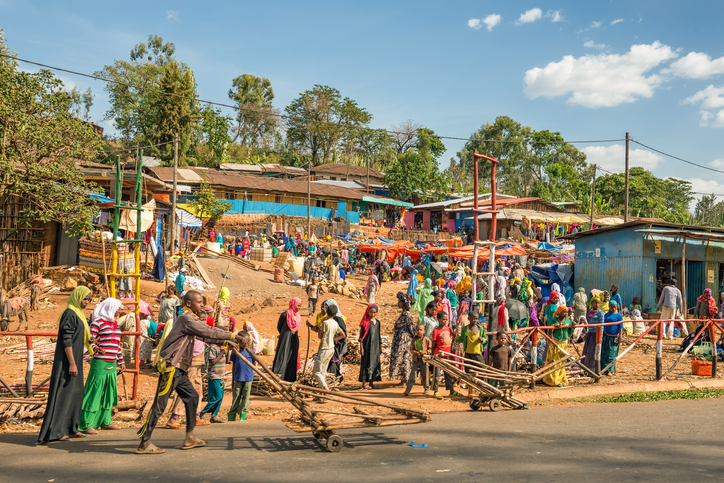
In 2017, foreign aid from official donors totaled over $146.6 billion. The bulk of this aid went to decentralizing or decentralized countries, in which regional or local governments are granted powers and resources. Localized governments are believed to be more accountable to voters because they are “downward-looking” and need to…
-

The Future of US Foreign Policy: An End to Liberal Internationalism?
•
Liberal internationalism, despite what the phrase may imply, does not favor the views of Democrats over Republicans. Instead, liberal internationalism features bipartisan values—including freedom, democracy, an open global economy, and respect for human rights. Defined by international engagement, it promotes liberal states’ engagement with other states’ affairs and wider global…
-

Can a Low-Carbon Economy Grow GDP?
•
In the face of climate change, the most effective way to ensure that greenhouse gas (GHG) emissions are slowed or stopped is by transitioning to a low-carbon economy. From an economic standpoint, however, this switch is no easy feat. A recently published study from the World Bank focuses on two…
-

Encouraging the Return of Talent: Evidence on Tax Incentives from Malaysia’s Returning Expert Program
•
High-skilled workers are continuously migrating. According to the World Bank, in 2010 there were approximately 45 million tertiary-educated migrants globally, which represents a 75 percent increase since 2000. High-skilled workers are essential for research, innovation, and development in international economies. Governments in both high-income and low-income countries recognize the importance…
-

Projecting the Economic Implications of Carbon Pricing in China
•
As one of the largest greenhouse gas emitters, China has recently been increasing its efforts to reduce carbon dioxide emissions, which is the largest contributor to climate change. One of China’s goals, as set in last year’s Paris Agreement, was to cut emissions by 60 to 65 percent per unit…
-

Reading the Tea Leaves: Labor Rights Violations on India’s Tea Plantations
•
Tea is the second most consumed drink in the world, second only to water. Over three million tons of tea are produced every year worldwide. Much of that production takes place in India, which has the second highest level of tea production of any nation in the world. Yet, in…
-

Is Training Informal Healthcare Providers The Solution to India’s Doctor Shortage?
•
India, like other developing countries, is struggling with a scarcity of formally trained medical professionals, especially in rural and isolated areas. This gap has fueled the proliferation of informal healthcare providers, known pejoratively as “medical quacks.” These untrained providers provide more than 70 percent of primary care in rural India.…
-

Uncovering the Demographics of the Poorest People in Developing Nations
•
Global poverty has been decreasing over the past two decades as a result of fast-paced economic growth. The number of people living in extreme poverty, which is defined as a household subsisting on less than $1.90 a day, fell by more than 60 percent over this period. This reduction surpassed…
-

How Organizational Changes Can Increase Competitiveness: Evidence from Brazil
•
Productivity is a fundamental concept in business because it encompasses how employees, firms, and the economy as a whole efficiently transform their inputs into outputs. From the macroeconomic perspective, productivity is often analyzed using aggregate industry data in order to better understand the trends and drivers of economic growth. Likewise,…
-

The Impact of Financing on Labor Markets in Developing Countries
•
Most firms in today’s economy are dependent on financial services such as lending or insurance. Developed countries are at the forefront of financial availability in terms of both institutions and regulations. By ensuring broad access to finance, countries provide support to the firms that operate within their borders, supporting economic…