
Violence
-
Why Are Mexican Political Candidates Getting Killed?
•
The 2018 elections were not only the largest in Mexico’s history, but also the most violent. From September 2017 to June 2018, 48 political candidates were killed during their campaigns. Was this violence politically motivated? A consequence of the criminal activity of the drug cartels? Was it a combination of…
-

Aggression and Video Games: Do Violent Video Games Induce Aggressive Attitudes and Behaviors?
•
Video games are often cited as a cause of mass violence. In the 1990s, President Bill Clinton asked federal agencies to investigate violent media. More recently, National Rifle Association CEO Wayne LaPierre directed blame toward video games in the wake of the 2012 Sandy Hook Elementary School shooting. President Trump…
-

University of Chicago’s Interdisciplinary Conference on Violence
•
Violence may be a complex, wicked problem. Solutions to it are not necessarily true or false, just good or bad. It is a symptom and cause of other wicked problems like poverty, unemployment, education and social inequality—the topics worthy of “policies.” To solve wicked problems, policymakers and practitioners are increasingly…
-
Bridging social science, policy and community: engaged research
•
If you ask a social researcher—psychologist, sociologist, cultural anthropologist—why they chose their profession, you might hear something like, “to help people,” but western social research is sometimes criticized for failing to help those who may need it most: groups on the underside of the power differential. When applied social research…
-

When Helping Hurts: The Unexpected Costs of Post-War Reconciliation
•
War! What is it good for? Civil war dissolves social structures and threatens personal livelihoods, domestically displacing both combatants and civilians. Even after hostilities cease, individuals and communities face a long and daunting recovery process. Reconciliation between victims and perpetrators of violence can be particularly difficult in addressing lingering emotional…
-

Back to the Future: A Duke historian’s take on modern terrorism
•
Duke University professor Dr. Martin Miller discusses important historical trends in terrorism, root causes, and how we should think about breaking the cycle.
-

The Power of the Pen: E.J. Dionne on Journalism, Politics, and Propaganda
•
Washington Post columnist E.J. Dionne discusses journalism’s impact on everything from the upcoming 2016 Presidential race to countering extremist propaganda.
-
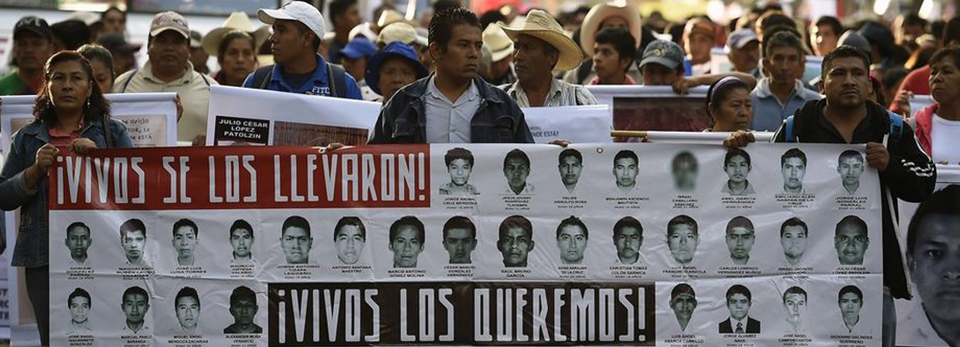
Violence in Mexico: Beyond Ayotzinapa
•
The horrifying Ayotzinapa massacre is just the tip of the iceberg in a country with high levels of crime, assassination, and violence in general: an infographic by the Chicago Policy Review.
-

Live Fast, Die Young, Defend Your Status: The Code of Retaliation
•
A harsh childhood can lead to a life strategy that condones violence in response to status threats. An economic game shows that such a worldview is linked to heightened envy in unfair situations.
-

Stop, Children, What’s That Sound? The Unintended Consequences of Police Contact on Juveniles
•
Study finds that “stop, question, and frisk” interactions between juveniles and police lead to an enhanced likelihood of future youth delinquency.
-

Another Path: Can school-based gang prevention programs show youth a way out?
•
An evaluation of the G.R.E.A.T. program, implemented as a school-based response to gang activity among youths, finds that students enrolled in the program are less likely than their peers to join gangs or have negative attitudes towards the police.