
Last Updated on June 8, 2026 by Chicago Policy Review Staff
The war of choice in Iran is not going very well for the United States. While the Iranian leadership has largely been decimated, the regime still stands with newly amassed leverage.
While there is technically a cease-fire in effect as of this writing, no fundamental agreement has been reached on Iran’s nuclear program, its treatment of dissidents, or its agreement to permanently allow Freedom of Navigation in the Persian Gulf.
The Iranians are now leveraging this newfound power over the world energy market and world agricultural market due to its stranglehold on the Strait of Hormuz. Iran also has the capability of restarting its nuclear program, and it is highly likely that it retains enough enriched uranium to put it within months, to a year of having functional nuclear weapons.
Massive bombing alone is unlikely to change the situation. Currently, the options for the United States now do not look positive: either back off and grant the Iranians power that they did not have prior to this war or escalate and bring in American ground troops to meet the narrow and shifting war aims of President Trump.
President Trump’s insistence that our European Allies help reopen the strait has met with predictable apathy given his ambivalence about the NATO alliance and unwillingness to consult with the Allies on the Iranian War from the beginning. However, President Trump has always prided himself on his ability as a deal maker. The opportunity exists for him to make a deal with the European Allies that will go a long way toward reimagining this crisis as the opportunity to put together a new post-post-war Alliance for the 21st century. Without this new, broader security framework, the elimination of Iran’s nuclear capability and the reopening of global trade to normalize the energy, fertilizer and food markets will be increasingly difficult.
The options are not at all appealing and this is bad news for the United States, the world and the Iranian people. The barbaric theocratic Iranian regime that has financed proxy terrorist armies around the region, and terrorized its own people, will only be emboldened by its ability to stand down two of the world’s most powerful armies.
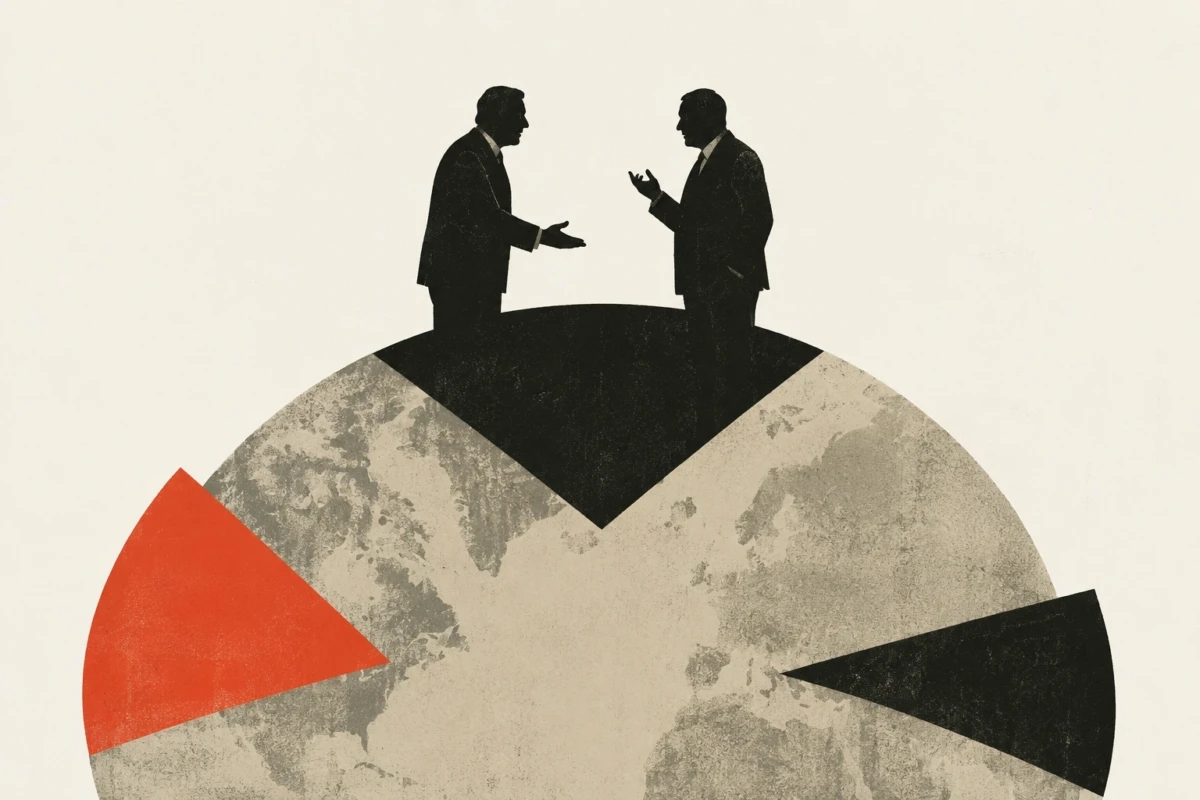
Thus, a new Grand Bargain is needed. It would require the United States to reembrace our European allies in a world where the Russians, Chinese, Iranians and North Koreans are finding more common ground than ever before.
An outline of the Grand Bargain would entail the following:
- The United States recommits to NATO and to honoring “Article 5,” the common defense pact. American bases, troops and nuclear umbrella remain the backbone of the NATO alliance.
- The NATO allies commit to accelerating their 5% spending promise on defense requirements and defense- and security-related preparedness by five years, to 2030 instead of 2035.
- The United States drops its claim toward Greenland
- The NATO allies commit to helping the United States reopen the Strait of Hormuz and end Iran’s nuclear program by confiscating any enriched uranium it has. This would require a multilateral, NATO-led ground force. International monitoring must return, as in the original Obama era deal.
- The United States recommit to the integrity of Ukraine and to rejoin the NATO allies in wholehearted rejection of the expansionist policies of Putin’s Russia and helping to provide Ukraine with the war material it needs to win its defensive war.
There is little doubt that without this crisis in Iran, President Trump would not entertain these ideas as they run counter to his isolationist and imperialist tendencies. However, the “facts on the ground” have changed and a Grand Bargain may be the only option to salvage an acceptable outcome for the United States, while appealing to his interest in deal making in the international arena.
There is also some precedent for such a norm-busting presidential change of heart. The opportunity to remake the European alliance could be President Trump’s “Nixon goes to China” moment.
President Trump is as strong an anti-internationalist as President Nixon was an anti-communist. Embracing an alliance he had previously scorned would give President Trump the same reputation for situational awareness and flexibility as it gave to President Nixon in 1972. It is the right thing to do for this crisis and to reestablish a crucial alliance in an increasingly hostile world.
As it becomes clearer to the president and his advisers that the war won’t end by furthering the air campaign or negotiation from the current weak position, they will likely consider new options. The question remains, would President Trump ever do such a Grand Bargain and what circumstances would lead him to consider an option which was previously unthinkable?
This president is ahistorical, but he does seem to crave historical and international acclaim.
He does not have to be an astute reader of history to remember, from his own lifetime, that the legacies of Lyndon Johnson and Jimmy Carter, were ruined by the failures in Vietnam and Iran. Carter’s landslide loss in the 1980 elections and LBJ’s decision not to run for re-election in 1968 are very much tied to their foreign policy disgraces.
Avoiding such a similar reputational fate could be motivating enough to President Trump to at least consider a course correction.
If new life can be breathed into the NATO alliance, there will be other opportunities for like-minded countries, such as Japan, South Korea, India, Israel, the Gulf States, Brazil, Australia, Mexico, Canada and others to become increasingly aligned allies against the axis of resistance featuring Russia, China, North Korea and Iran.
Vice President Vance has recently spoken of a “Grand Bargain,” but his reference was a negotiated settlement with the Islamic Republic of Iran. The United States would be in a much stronger position to have a favorable outcome to any eventual negotiation with Iran if the first “Grand Bargain” strengthens the traditional alliance with NATO. This is the alliance that has largely kept the world safe from repeating the horrific tragedies of the first half of the twentieth century.
A renewed NATO “Grand Bargain” would give the United States and the world a much more viable foundation for common ground in the struggles to come in the 21st century, namely the fights against autocracy, income inequality and climate change.