
Last Updated on February 3, 2026 by Chicago Policy Review Staff
By any measure, cricket is more than just a game. Historian C.L.R. James famously wrote that “Cricket is first and foremost a dramatic spectacle. It belongs with theatre, ballet, opera and the dance.” Today, with an estimated global audience exceeding two billion, cricket is deeply embedded in the political and cultural life of South Asia, Australasia, the Caribbean, and the United Kingdom.
Yet in contemporary South Asian cricket, the drama is no longer confined to the pitch. Cricket has always reflected politics in the region, but increasingly geopolitics is shaping the sport’s very institutions like determining where matches are played, who is allowed to compete, how revenue is distributed, and which boards wield power within global governance structures. What was once an arena that absorbed political tensions has, in recent years, become one where those tensions are actively enacted.
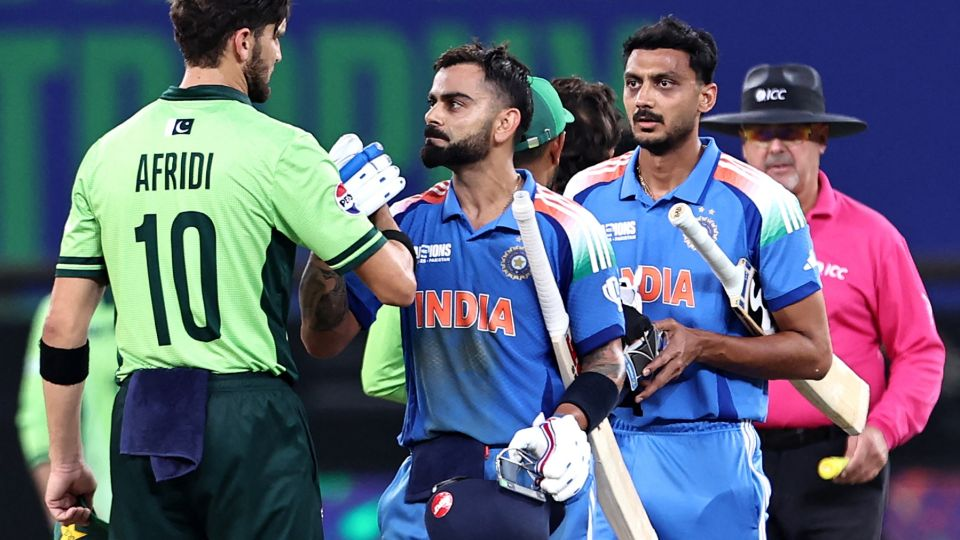
This shift is most visible in the rivalry between India and Pakistan. Historically, these contests are not merely sporting events; they are geopolitical spectacles, watched by hundreds of millions and freighted with the unresolved history of Partition, war, and nationalism. Each game is played and watched with charged environments that make it clear that this rivalry has deeply reshaped “The Gentleman’s Game”.
Origins of the Rivalry
India and Pakistan first met on the cricket field in 1952, shortly after Partition had violently divided British India into two nations. Since then, the teams have played over 200 official matches across Tests, One-Day Internationals, and T20 formats. These encounters consistently rank among the most-watched sporting events in the world, often eclipsing global tournaments such as the Super Bowl and UEFA Champions League finals with digital peaks crossing 600M viewers for a single match.
Cricket has become a source of national pride for both nations and consequently cricket boards in both countries symbolize national identity. Pakistan is governed by the Pakistan Cricket Board (PCB), while India’s team is administered by the Board of Control for Cricket in India (BCCI), the world’s wealthiest and one of the most influential cricket authorities in the ICC. For decades, bilateral tours served as rare moments of engagement between two hostile neighbors. “Cricket diplomacy” in the 1980s and 1990s saw leaders attend matches in hopes of easing tensions created from border conflicts. Yet these exchanges have steadily eroded. Pakistan last toured India in 2012–13, and bilateral series have since been replaced by occasional meetings in multinational tournaments often played on “neutral venues.”
Geopolitics on the Pitch
The deterioration of sporting ties between the two nations often mirrors political conflict. Border clashes, terror attacks, and diplomatic crises have increasingly spilled into cricket. BCCI officials have frequently cited security concerns to avoid touring Pakistan, most notably during the Asia Cup in 2023, which Pakistan hosted but India played in Sri Lanka under a “hybrid model” citing security concerns for their players.
More recently, following the Pahalgham attack in Indian Occupied Kashmir in which 26 civilians lost their lives on 22 April 2025 (events Pakistan has denied involvement in) emerged a symbolic distancing between players, including the suspension of traditional handshakes between teams in high-profile encounters. While such gestures are minor in isolation, to the cricketing world they reflect how the game has become a proxy battlefield for national grievances. Cricket (and now arts and cultural events), once imagined as a bridge between the two nations, is now often used to reinforce political divides rather than soften them.
Power, Politics, and the BCCI
At the heart of cricket’s political economy stands the BCCI. With India contributing the largest television audiences and sponsorship revenues, the board wields disproportionate influence over the sport’s global governance.
This power became especially visible under Jay Shah, the son of Indian Home Minister to the central government, Amit Shah, a senior leader of the ruling right-wing Bharatiya Janata Party (BJP). Jay Shah was appointed BCCI Secretary in 2019, later became president of the Asian Cricket Council, and in 2024 was elected Chairman of the International Cricket Council (ICC), the sport’s global governing body. A similar move has been made by the PCB by appointing Mohsin Naqvi, the interior minister of Pakistan as its Chairman. This move was also widely questioned as it signalled the involvement of Pakistani political elite in the sport.
Critics argue that this consolidation of power has blurred the line between sport and state. One of the most controversial examples is the ICC’s revenue-sharing model. Under the 2024–2027 financial cycle, India alone is projected to receive roughly 38.5% of ICC revenues, with England and Australia also receiving significantly larger shares than other member nations. Earlier governance reforms which are often referred to as the “Big Three” era were widely criticized by cricketing boards for concentrating authority among India, England, and Australia at the expense of smaller cricketing nations.
Of course, it would be remiss not to acknowledge that this consolidation of power has been enormously beneficial for the BCCI and for Indian cricket more broadly. Securing the largest share of global revenues has translated into world-class infrastructure, deeper domestic competitions, higher player salaries, and unprecedented commercial growth. From an economic and developmental standpoint, the model has undeniably strengthened India’s position at the center of the cricketing world. Some would also argue, given that the “Big Three” bring the highest number of viewers, receiving a higher share of the revenue is a fair result. Objectively, for India, this transformation has been a net positive even as it raises difficult questions about equity, governance, and the long-term health of the global game.
Consequently, Pakistani cricket has been compelled to chart an alternative path beyond the traditional centers of power. With limited access to India’s commercial ecosystem and exclusion from the Indian Premier League (IPL), the Pakistan Cricket Board has increasingly relied on international partnerships and player mobility to sustain relevance and revenue. Pakistani cricketers have become prominent figures in overseas leagues such as Australia’s Big Bash League, while the Pakistan Super League (PSL) has been built by actively recruiting foreign stars. In the absence of bilateral series with India and with fewer financial guarantees from global governance structures, Pakistan has been forced to turn outward and leverage its talent pool and diaspora to remain embedded in the global game, even as the sport’s economic gravity continues to shift elsewhere. This is also in part due to the sheer lack of domestic cricket structure and stability in Pakistan which has consistently been plagued with poor management of team players, coaches and club cricket leagues.
Exclusion and Its Consequences
Political decisions have also shaped player mobility in the game. Since 2009, Pakistani cricketers have been effectively barred from participating in the IPL, the world’s most lucrative T20 competition, following the 26/11 Mumbai attacks and the subsequent breakdown in bilateral relations between the neighboring nations. While Indian and Pakistani players appear in leagues worldwide, Pakistani players remain excluded from the IPL, depriving players of both income and global exposure whilst depriving IPL franchises to pick top Pakistani talent for their teams.
Tournament hosting has similarly become politicized. India’s refusal to tour Pakistan for major events has forced international bodies into logistical compromises, while Pakistan and recently now Bangladesh have at times cited “security concerns” to request neutral venues — rhetoric that mirrors earlier Indian justifications for avoiding Pakistan. For the upcoming 2026 T20 World Cup, Bangladesh has formally asked the ICC to stage certain matches in Sri Lanka. This action comes after the BCCI instructed an IPL franchise Kolkata Knight Riders to release Bangladesh national team player Mustafizur Rahman from its roster, highlighting how venue politics now ripple across the region. These actions reinforce perceptions that the BCCI increasingly “runs cricket,” shaping schedules, venues, and commercial priorities according to India’s political and economic interests.
The consequences extend beyond administrators to the players themselves. Public gestures, whether it’s celebrations referencing military events or symbolic refusals of traditional sporting courtesies, illustrate how athletes are drawn into political narratives they do not control. Such moments, widely amplified on social media, deepen polarization and reduce the possibility of cricket serving as neutral ground and even less so as a means to ease border tensions.
Scholars of sport diplomacy note that when governments intervene directly in sporting relationships, matches cease to function as sites of soft power and instead become extensions of conflict.
Why Politicizing Cricket Harms the Game
Sport has historically provided rare spaces where rival communities can coexist. Anyone who has watched students from India, Pakistan, Bangladesh, and Sri Lanka sitting side-by-side in university common rooms, cheering, arguing and laughing can attest to cricket’s unifying potential. Rivalries, after all, are not inherently destructive. They are the very essence of spectacle such as the All Blacks vs. Australia, El Clásico and Ashes cricket.
But when states weaponize sport by blocking tours, excluding players, or transforming matches into symbolic battlegrounds, the damage appears to be deeply structural.
There is also an economic cost to polarization and exclusion. India–Pakistan series are among the most commercially valuable fixtures in world sport. Analysts have long noted that regular bilateral cricket between the two nations could generate hundreds of millions in broadcast revenue, benefiting not only the boards involved but also the global game through development funding. Instead, when the cricket pitch becomes a proxy for political standoffs, it deprives fans of the sport’s greatest rivalry and reinforces inequalities within cricket’s global governance.
Safeguards for Cricket’s Future
Cricket’s history in South Asia cannot be separated from politics. From the trauma of Colonization and later Partition to decades of conflict, diplomacy, and uneasy coexistence, the game has always reflected the region’s deeper realities. Yet there is a profound difference between acknowledging that history to deepen neighboring ties and allowing contemporary power struggles to dominate the sport’s institutions.
The increasing concentration of authority within the BCCI, the exclusion of players from the world’s premier league, and the politicization of hosting and on-field conduct reflect a broader trend: cricket is no longer merely shaped by geopolitics but rather it is being used by it.
Meaningful improvement does not mean achieving the impossible task of removing politics from cricket, but the establishment of clear institutional safeguards. First, stronger firewalls between government ministries and cricket board leadership are necessary to preserve administrative autonomy and to reduce the perception that sporting decisions are driven by domestic political agendas. Second, the ICC must strengthen minimum governance and revenue-stability protections for smaller and less influential boards, ensuring that their participation in the global game is not undermined by shifting political alignments. Finally, explicit protections for player mobility to allow participation in leagues and tournaments is not indirectly constrained by geopolitical tensions to help prevent athletes from becoming collateral damage in political disputes.
As C.L.R. James noted, cricket is a “dramatic spectacle.” But if the drama becomes exclusively political, the game risks losing what has always made it extraordinary: its capacity to turn rivalry into respect, conflict into contest, and nations into opponents rather than enemies. For countries with such similarities in culture, language and shared history, as India and Pakistan have, cricket can, at its best, remind those who play and watch it that sporting rivalry need not erase humanity. To abandon that possibility is not only a political choice but a betrayal of the game of cricket itself.